

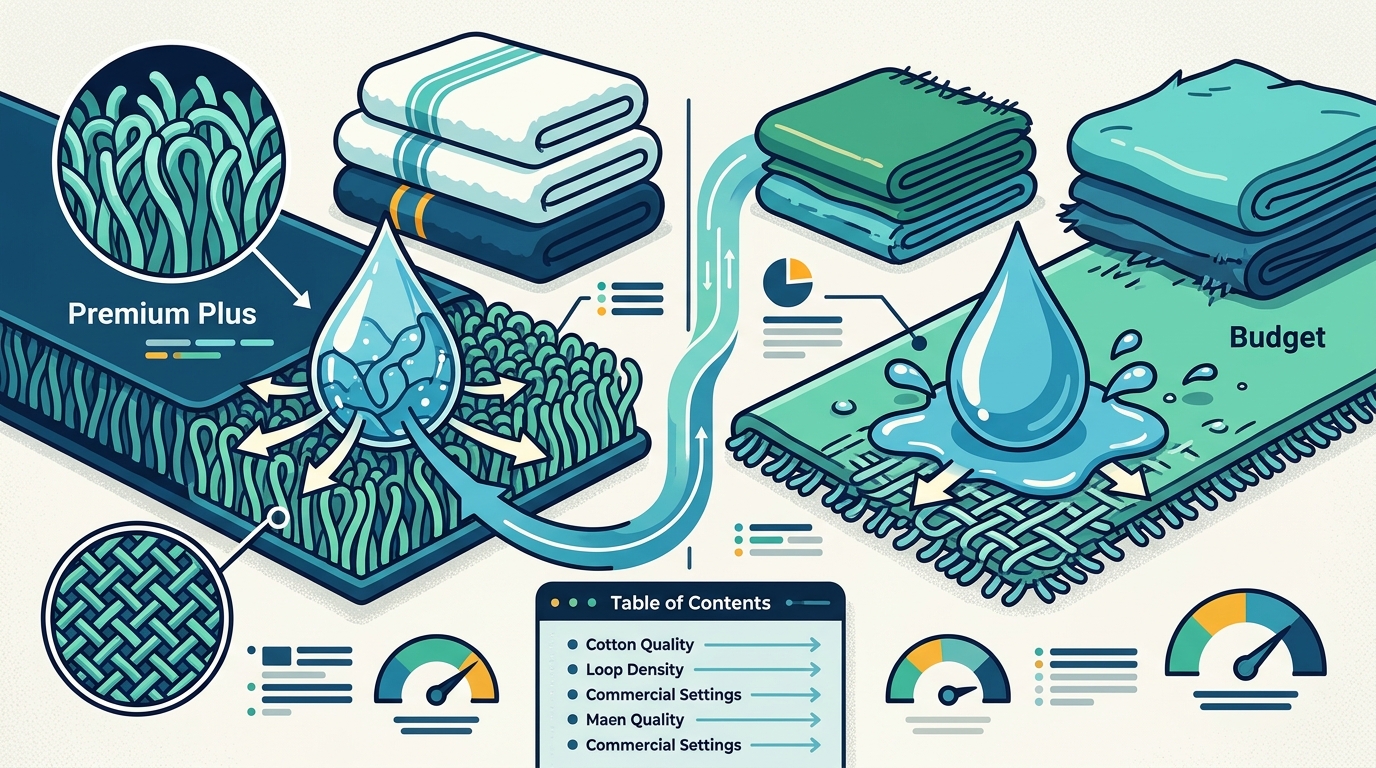
Premium towels absorb water better because they use higher-grade cotton with longer, denser loops and tighter weaves. Budget options often use shorter fibers or synthetic blends that repel moisture or dry slowly. Towel Hub explains how these structural differences impact daily performance in commercial and home settings.
The Role of Fiber Length and Quality
The core difference in absorbency lies in the cotton fiber itself. Premium cotton is defined by longer staple fibers that create stronger, more resilient loops. When a towel is made from long-staple cotton, the fibers can twist together tightly without breaking. This structural integrity allows the loops to remain open and fluffy even after repeated washing. Budget towels often use short-staple cotton or a blend of cotton and polyester. Short fibers are weaker and tend to break down faster, leading to a matted surface that resists water penetration.
At Towel Hub, our Premium Plus line utilizes high-quality cotton to ensure this fiber longevity. The longer fibers mean the towel can hold more water per square inch. This is not just about softness; it is about the physical capacity of the fabric to wick moisture away from the skin or surface. When you feel a premium towel, you are feeling the density of these intact, long fibers working together to capture liquid.
Loop Density and GSM Impact
Absorbency is directly correlated with the weight and density of the towel fabric. GSM (Grams Per Square Meter) is the standard metric used to measure this density. A higher GSM indicates a thicker, heavier towel with more loops per square inch. These extra loops create a larger surface area for water to be trapped. Budget towels typically have a lower GSM, meaning fewer loops and less capacity to hold water. They may feel light and dry quickly, but they also require more passes to dry a body or a large surface area.
For commercial buyers, this distinction is critical. A gym or spa needs a towel that can handle high-volume use without failing. Towel Hub provides detailed towel thickness guides that help buyers understand how GSM translates to real-world performance. A 24x50 bath towel with a higher GSM will absorb significantly more water than a thin economy version of the same size. This density ensures that the towel remains effective throughout its service life, rather than becoming a thin, ineffective wiper after a few washes.
Weave Structure and Loop Integrity
The way the fabric is woven plays a crucial role in how water is captured. Premium towels often feature a full terry weave, where loops are present on both sides of the fabric. This double-sided loop structure maximizes the surface area available for absorption. In contrast, some budget towels use a single-sided terry or a velour finish, where the loops are sheared flat. While velour looks sleek, the sheared surface has less depth to trap water. The loops in a full terry weave act like tiny sponges, pulling water into the core of the fabric.
Additionally, the integrity of the weave matters. Premium towels are often double-stitched or feature tuck-in selvage edges. This construction prevents the loops from unraveling or fraying during aggressive commercial laundering. If the weave breaks down, the loops collapse, and absorbency drops. Towel Hub’s Premium Plus bath towels are engineered to maintain this loop integrity over hundreds of wash cycles. This ensures that the absorbency you experience on day one is the same absorbency you experience on day one hundred.
The Impact of Synthetic Blends
Many budget towels incorporate polyester or other synthetic fibers to reduce cost and increase durability. While polyester is strong, it is hydrophobic, meaning it naturally repels water. When cotton is blended with polyester, the synthetic fibers can interfere with the cotton’s ability to wick moisture. The water may sit on the surface of the synthetic fibers rather than being drawn into the cotton loops. This results in a towel that feels damp for a longer period and dries more slowly. For a user, this can feel like the towel is not working as hard as it should.
100% cotton towels, particularly those in the Premium Plus grade, avoid this issue entirely. Cotton is hydrophilic, meaning it attracts and holds water molecules. By using pure cotton, Towel Hub ensures that the towel’s primary function is not compromised by synthetic additives. This is why our economy towels are also 100% cotton, but the difference in fiber quality and GSM is what separates the performance tiers. The pure cotton composition allows for consistent, predictable absorbency that does not degrade as quickly as blended fabrics.
Commercial Longevity and Cost Efficiency
In a commercial setting, absorbency is not just a comfort feature; it is a cost driver. If a towel does not absorb water efficiently, staff must use more towels or spend more time drying surfaces. This increases labor costs and accelerates the wear and tear on the linen inventory. Premium towels, with their superior absorbency and durability, last longer in service. They maintain their performance profile for a longer period, reducing the frequency of replacement. This makes them a more cost-effective choice over time, despite a higher initial purchase price.
Towel Hub helps businesses make this calculation by offering free samples of our various quality grades. By testing a Premium Plus towel against an economy option in your specific environment, you can see the difference in absorbency and durability firsthand. This practical approach allows you to make an informed decision based on your operational needs. Whether you are outfitting a hotel, a gym, or a spa, understanding the science behind absorbency helps you choose the right towel for the job.
Key Takeaways
- Fiber Length: Premium towels use long-staple cotton that creates stronger, more absorbent loops.
- GSM Matters: Higher GSM indicates greater density and water-holding capacity.
- Weave Type: Full terry weaves offer more surface area for absorption than sheared velour.
- Material Purity: 100% cotton is hydrophilic, while synthetic blends can repel water.
- Durability: Premium construction maintains absorbency over hundreds of wash cycles.
- Cost Efficiency: Better absorbency reduces labor time and extends towel lifespan in commercial use.
Frequently Asked Questions
What is the main reason premium towels absorb better?
Premium towels use higher-grade cotton with longer fibers and higher GSM, creating denser loops that trap more water.
Do synthetic blends affect towel absorbency?
Yes, synthetic fibers like polyester are hydrophobic and can reduce the overall water-wicking ability of the towel.
How does GSM relate to water absorption?
Higher GSM means more fabric weight per square meter, which translates to more loops and greater water capacity.
Can budget towels be improved with washing?
While proper washing helps, the structural limitations of short-staple fibers and low GSM in budget towels cannot be fully overcome.
Where can I test towel absorbency before buying?
You can request free samples from Towel Hub to compare the performance of different quality grades in your facility.
Conclusion
Understanding the science behind towel absorbency helps you make smarter purchasing decisions. Premium towels outperform budget options due to superior fiber quality, higher density, and pure cotton composition. For businesses looking to optimize their linen inventory, Towel Hub offers a range of high-performance options designed to last. To see the difference for yourself, to discuss your specific needs and request samples.